Search results for tag #freesoftware
![[?]](https://hostux.social/system/accounts/avatars/000/194/506/original/49ba2d821222d160.png)
A #ThankGNU! to Andy Kopra and Andrea Bocci for helping the FSF to promote #FreeSoftware. To see a longer list of those who have helped us financially in our advocacy for #SoftwareFreedom and awareness, visit: https://u.fsf.org/4ao
Alt...
Image that says 'Thank GNU' with a GNU head by Vijay Kumar Bagavath Singh
If you want to hire a problem-solver, hire someone with #FreeSoftware experience! Advertise your job opening on our #job page: https://u.fsf.org/46v #FSF
Protecting the integrity of the (A)GPL is an essential component in protecting user freedom: https://u.fsf.org/4b2 #FreeSoftware #copyleft #GPL

Alt...
A stack of papers with an orange background
Protecting the integrity of the (A)GPL is an essential component in protecting user freedom: #FreeSoftware #copyleft #GPL

Alt...
A stack of papers with an orange background
As stated by Lewis Clarke, a #FSF student associate member, people should control technology. If you agree that technology shouldn't control people, support #Freesoftware and the #FSF with an associate membership: https://my.fsf.org/join
A #ThankGNU! to Sean Mccauliff and Valerio Poggi for helping the FSF to promote #FreeSoftware. To see a longer list of those who have helped us financially in our advocacy for #SoftwareFreedom and awareness, visit: https://u.fsf.org/4ao
Alt...
Image that says 'Thank GNU' with a GNU head by Vijay Kumar Bagavath Singh
Local meetups are great for #FreeSoftware of all ages and experiences: https://u.fsf.org/4ag #FSF #LibreLocal
Supporting #FreeSoftware was more than enough of a reason for Henry Chaney to become a #FSF associate member: https://my.fsf.org/join
A #ThankGNU! to Podbielniak Giving Fund and Ramana Kumar for helping the FSF to promote #FreeSoftware. To see a longer list of those who have helped us financially in our advocacy for #SoftwareFreedom and awareness, visit: https://u.fsf.org/4ao
Alt...
Image that says 'Thank GNU' with a GNU head by Vijay Kumar Bagavath Singh
![[?]](https://totsipaki.net/social/nparafe/s/avatar-accb7c42a0c26467865911e949e852b0.png)
This year, from what I watched online, a few speakers tried to bring politics back into the room. They talked about things like technological sovereignty and the war. After years of carefully avoiding politics, that shift is genuinely welcome.
But the real question is: who are you talking to, and what do you think it will achieve?
If your strategy is to appeal to the EU, or to the supposedly “good intentions” of big corporations, then you’re not fixing the movement’s confusion - you’re reinforcing it.
Because in Brussels and in C-suite offices, the only constant is money and power. And that’s why they will never seriously confront Big Tech, or the US state that protects it. The whole “we just need better policy” or “we can partner our way out of this” story collapses the moment it runs into actual interests.
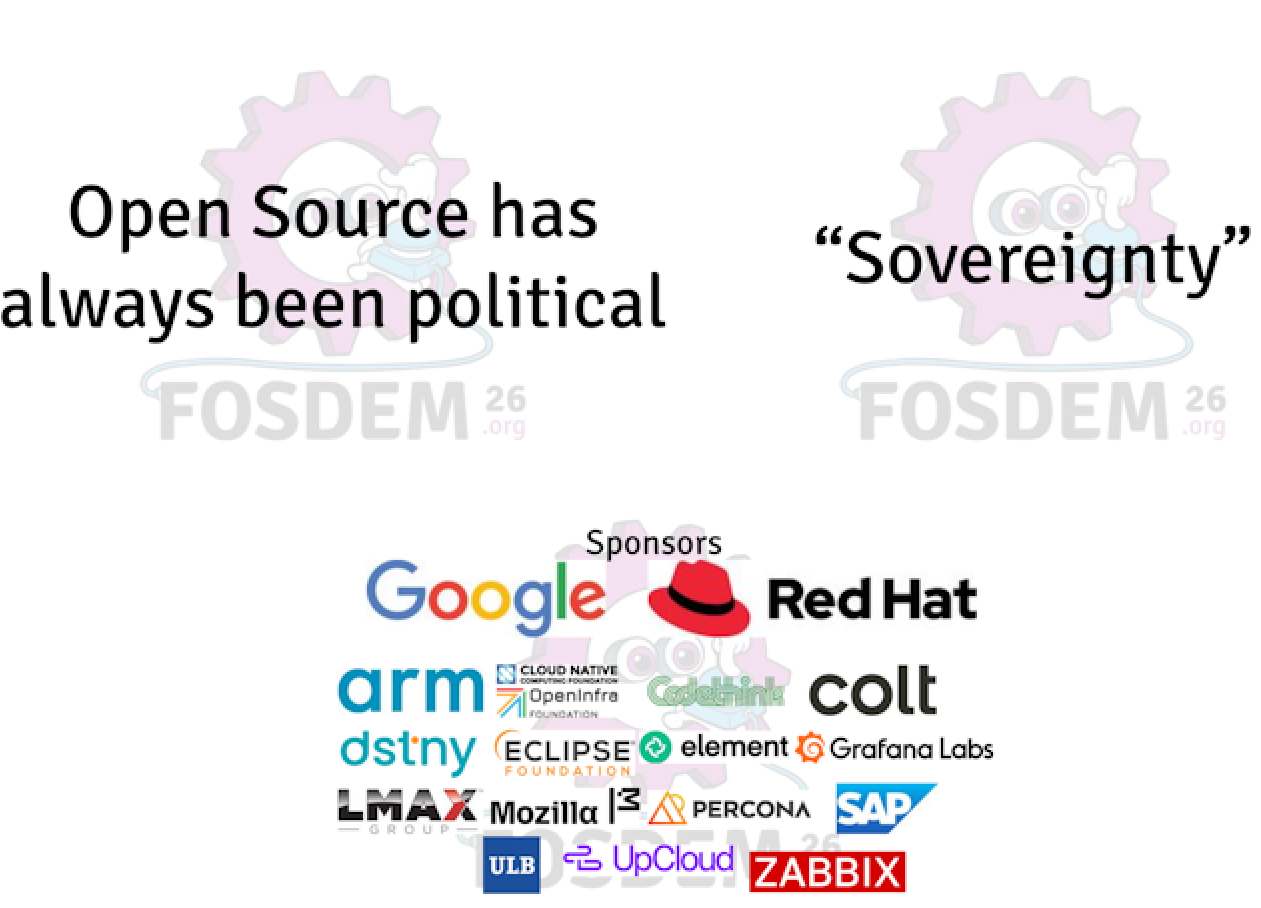
And the irony is impossible to miss: FOSDEM itself takes sponsorship money from the very companies shaping the problem - including Google, and IBM (via Red Hat). Whatever you think of sponsorship in general, it’s hard to square that with any serious claim of challenging US tech hegemony.
Technological radicalism didn’t come from boardrooms or polished conference stages. It came from communities: from messy, stubborn, principled people building things together with #FreeSoftware and from the hacker ethic, with its insistence on autonomy, curiosity, and refusal to ask permission.
If we want to keep the spirit of dissent - and the possibility of genuinely free creation - alive, we have to stop chasing legitimacy from institutions that will never be on our side. We have to rebuild from the roots: our communities, our practices, and our politics.
Alt...
Three slides from https://fosdem.org/2026/events/attachments/SFKNTZ-welcome_to_fosdem_2026/slides/265524/2026-01-3_k4oppqv.pdf. 1) Top left has the phrase "Open Source has always been political", 2) top right, has the world "Sovereignty" and the third has the sponosrs of fodem (including Google and Redhat-IBM)